


Quick OverviewIt's getting quite difficult to introduce this increasingly complex topic at a scale that is genuinely "quick," but we'll give it our best shot! Two Different Systems There are two active sonar systems deployed by Navies around the world. The Mid-Frequency Active Sonar, introduced in the late 1980's, has been fairly widely deployed for over a decade, and has been implicated in several mass strandings of beaked whales and other species. The newer Low-Frequency Active Sonar (LFAS) is operational on two US ships and one British ship, so far. The use of mid-frequency sonars on over 150 NATO and US ships is considered crucial by military planners, as they can detect "quiet" submarines and be used to protect important shipping lanes. Quiet diesel subs have been deployed by Iran (3), Russia (18), North Korea (25) and China (58). Both systems project high-intensity sound into the ocean, and listen for echoes returning from targets. Source levels of both systems are 235dB (roughly equivalent to 170dB in air; sound measurement in water results in higher dB ratings). The low-frequency system is designed to be able to provide useful detection over long distances (hundreds of kilometers), since low-frequency sound travels well in water, while the mid-frequency system is effective over a range of a few tens of kilometers. Strandings The mid-frequency system seems to have caused strandings in specific bathymetric (sea floor profile) conditions, which are not yet completely understood. The most common stranding victims are beaked whales, from several deep-diving species rarely seen near shore. Some recent research suggests that their complex dive patterns could be changed in response to sonar signals (either by surfacing more quickly than usual, disrupting a series of near-surface dives between deep dives, or triggering an extended fleeing response).
A Cuvier's beaked whale breaches off the coast of Italy. Mass stranding and mortality events coincident with mid-frequency sonar training exercises (NATO and US) have occurred (though not always with clear causal proof) in the Canary Islands (2004, 2002, 1989, 1986, 1985); Madeira (2000); Spain (2006); the U.S. Virgin Islands (1999, 1998); and in Greece (1996). One of the best documented incidents occurred in the Bahamas in 2000 when 16 whales of three species stranded along 15 miles of shoreline during a Navy exercise; some researchers suggest that the entire local population of beaked whales may have been at least temporarily decimated, as few animals were seen in the next couple of years. The U.S. Navy later acknowledged in an official report that its use of sonar was the likely cause of the stranding; they stressed, however, what they saw as a unique confluence of bathymetric conditions (deep near-shore canyons, with shorelines limiting escape routes), along with multiple ships using sonar for several hours, that led to the strandings. It is quite possible, though uncertain (since the location of the whales when exposed is unknown) that the whales were exposed to sounds much lower than accepted safety levels of 180-210db; this would be consistent with various theories that suspect that changes in behavior trigger the injuries that have been observed, rather than intense sound exposure causing direct injury. A common set of physical injuries has been observed in many of these strandings, involving tissue lesions caused by expanding nitrogen bubbles. This is similar to "the bends" in humans, and these injuries, known as "gas and fat embolic syndrome" is considered the one clear "smoking gun" of sonar-induced injuries. Most theories now focus on changes in dive patterns causing these injuries, though some research continues to explore whether direct exposure to sound waves could be involved. When these injuries are NOT present, the tendency of government agencies is to consider the cause of the stranding to be inconclusive. The possibility remains that there are other physiological injuries or behavioral responses triggered by sonar that are, as yet, unknown. So far, with limited deployment, no strandings have been associated with Low-frequency active sonar systems. Over the past decade, roughly 60 fatalities have occurred in strandings that seem to have been associated with mid-frequency active sonar exposure. While others may have been injured and died at sea, it should be noted that 36,000 cetaceans have stranded in the US over the same period, and that up to 300 ships worldwide using mid-frequency sonar account for hundreds to thousands of periods of sonar use per year, in both training exercises and routine operations. Still, evidence of changes in behavior bear close scrutiny, and calls for using the best possible monitoring for whales; reducing the intensity or suspending exercises when visibility is low are among the additional safety measures favored by environmental advocates and at times imposed by the courts. Lawsuits Each of the three key lines of legal challenge to active sonar training have been resolved: #1: LFAS In 2003, the US Navy and the NRDC settled a lawsuit challenging EIS governing the global deployment of LFAS; both parties agreed to limit ongoing training missions to a region of the West Pacific which is relatively free of cetacean populations and of is of great strategic importance to the Navy. In July 2007, after preparing a revised Environmental Impact Statement, the Navy received permits to move forward with LFAS deployment worldwide. Two ships are active as of late 2007, with plans for two more by 2011; both LFAS ships are still deployed in the western Pacific, monitoring Chinese and Korean submarine activity. In early 2008, NRDC again challenged the new EIS; the judge who will hear the case ordered the Navy to avoid several key biologically-rich areas worldwide, most of which are not likely to be near LFAS deployment anyway. In August 2008, the Navy and NRDC agreed to a settlement in which both training and operational use of LFAS will continue to be limited to defined (though somewhat expanded) areas of the Pacific Ocean, though there are broad exemptions to these limits when Naval commanders deem it necessary in search of potentially hostile submarines. The Navy is proceeding with a Supplemental EIS that is aimed at re-establishing the right to deploy LFAS in other oceans. #2: Mid-frequency program Meanwhile, in October 2005, a year after submitting a letter formally asking for negotiations, NRDC and several allies filed a suit in US District Court, challenging the current operational procedures for mid-frequency sonar. The suit raises a few related issues including establishing adequate compliance for mid-frequency sonar under NEPA, ESA, and the MMPA, since it is apparent that there are "takes" occurring, as well as pressing the Navy to adopt additional mitigation and safety measures, such as avoiding sonar use in areas likely to be beaked whale habitat. [SEE INITIAL PRESS RELEASE ON SUIT] During 2006 and 2007, the Navy and the NRDC wrangled in court over the Navy's motion to dismiss (based on the plaintiffs not having details about when and where supposed violations took place), and the NRDC's request for records necessary for addressing the substance of the case. By the end of 2007, a court-mediated compromise led to the release of some Navy records, and the case continued to work its leisurely way through the halls of justice. In late 2008, the parties reached a settlement that removed the case from the courts, and provided for more communication and transparency between the parties, as well as formalizing the EIS and research programs the Navy had initiated in the years since the dispute began. Perhaps partly in response the threat of litigation, in late 2005, the Navy announced its intent to begin NEPA analysis of sonar trainings worldwide. The first few of these EIS's have been completed, and other training ranges are also queued for EIS development during 2009. (Scroll down for links to EIS's in process) #3+: Mid-frequency specific permits In January 2007, the Pentagon granted the Navy a 2-year exemption to the Marine Mammal Protection Act; the exemption is aimed to give the Navy time to prepare necessary EIS's and avoid suspension of exercises due to lawsuits. In the interim, the Navy is working closely with NOAA Fisheries (NMFS) to obtain permits and agree on mitigation measures to govern the exercises. However, provisions of NEPA requiring environmental analysis remain in force, and have continued to provide the basis for court challenges (NEPA does not have the built-in exemption options that were activated regarding the MMPA). The Navy has established a set of operational and mitigation measures that NMFS has considered sufficient for issuing necessary permits; legal challenges to these permits and the sonar trainings are generally asking for more stringent protection measures, including larger bugger zones and reducing the volume or shutting down sonar systems in more situations. Other lawsuits have been filed by the same plaintiffs to challenge mid-frequency sonar training protocols at the RIMPAC exercises in Hawaii in 2006, and along the southern California coast in 2007. The results of the Hawaii suit are somewhat obscured by the spin from each side; NRDC took some credit for several modest but useful new safety measures, while the Navy says that they simply made formal commitments to operational standards already in place but not required by the permits issued by NOAA Fisheries, with the only concession being one additional marine mammal observer on each ship. The California case is ongoing, with the court mandating additional safety measures in January 2008, upheld by the 9th Circuit Court of Appeals, and currently awaiting a promised hearing at the Supreme Court during its fall 2008 term. As of late 2008, the 2005 challenge regarding program-wide Mid-frequency sonar compliance issues remains active, while site-specific rulings adding extra safety measures have been issued by a District Court in Hawaii and a District and Appeals Court in California. The California Appeals Court ruling was appealed (in part) by the Navy, and the Supreme Court ruled that the Navy courts should have been more deferential to Navy concerns about additional restrictions. [SEE AEI COVERAGE OF SUPREME COURT RULING: SUMMARY AND COMMENTARY] Meanwhile, the Navy's EIS's have begun rolling out during 2008; the Navy is clearly hoping that these EIS's will provide a legally-defensible scientific basis for its current safety measures. Ed. note: It is becoming apparent that the Navy feels strongly that it is doing enough to protect whales, and considers some of the judicial decisions to have been lacking scientific merit or have prohibited aspects of training it considers imperative. What may be overlooked by the Navy and the media, is that this and other related rulings are looking at evidence of behavioral impacts that occur at lower sound levels--some of the court-ordered additional safety measures are apparently aimed at minimizing possible injury or avoidance at longer ranges than the Navy considers necessary. Also, these rulings have been spurred by the Navy's earlier decisions to not conduct full NEPA-required environmental assessments. The Navy is now in the midst of EIS's for many naval training ranges, but current activities are not yet in compliance (the MMPA exemption is in place, but most current legal challenges are based on NEPA requirements or other laws). For a far more comprehensive look at the scientific questions that underlie the many legal challenges—including questions about how many whales are being killed, the extent of behavioral disruption, and the effects of the additional safety measures imposed by the courts—see AEI Special Report: Sonar FactCheck [GO THERE] The Congressional Research Service has produced a report, updated periodically, that consists of a briefly annotated timeline of events related to active sonar and marine mammals, including scientific reports, strandings, and legal and regulatory developments. [DOWNLOAD 2007 VERSION(pdf)] [ABSTRACT OF 2007 VERSION ONLINE] [READ 2005 VERSION ONLINE] In response to legal challenges and the increasing controversy over the effects of active sonar transmissions on marine life, the US Navy has begun the process of developing Environmental Impact Statements for each of the Training Ranges where mid-frequency active sonar is used. Most of these sites have been hosting Naval training missions, including mid-frequency active sonar, for many years; however, this round of EIS development will likely set the standards by which MFAS is operated for years to come. The final documents are officially termed an EIS/OEIS (Overseas Environmental Impact Statement). In each case, the process begins with the release of a Notice of Intent to conduct an EIS/OEIS process, followed by a scoping period during which initial comments and concerns are submitted. Around two years later, a Draft Environmental Impact Statement (DEIS/DOEIS) is released, in which several alternatives are analyzed and a preferred alternative is identified; a 45- or 90-day comment period follows immediately. Another year or more later, the final EIS/OEIS is released, and is the basis on which necessary permits are issued. The Navy works closely with National Marine Fisheries Service scientists and regulators to develop what both agencies consider to be biologically prudent operational and mitigation plans, with final guidelines spelled out in the Incidental Harassment Authorizations issued by NMFS. Below is the list of Ranges where a Notice of Intent to conduct an EIS/OEIS. Scoping has been completed on them all, except the final one in the queue, Gulf of Alaska. The Hawaii Range Complex is leading the way, with a final EIS/OEIS released in time to govern the biannual RIMPAC (Rim of the Pacific) exercises in summer of 2008, which were subject to Federal Court scrutiny in 2006. Draft EIS/OEIS for six other projects were released in 2008, with 4 more due in 2009. Update: all the major training ranges have completed their initial 5-year EISs. Work has already begun on the reneweals of these permits, which will be required in each case, 5 years from the completion of the first EISs and permits. Hawaii Range Complex--completed Southern California Range Complex--completed Atlantic Fleet Active Sonar Training (AFAST)--completed Virginia Capes Range Complex--completed Jacksonville Range Complex (JAX Range Complex)--completed Navy Cherry Point Range Complex--completed Undersea Warfare Training Range (USWTR) Northwest Training Range Complex--completed Marianas Range Complex--completed Gulf of Mexico Range Complex (GOMEX)--completed Gulf of Alaska Navy Training Activities--completed NOAA Issues Authorizations for Hawaii Range Sonar Training - The Navy has received the necessary authorizations from NOAA's Fisheries Service to proceed with sonar training missions in the waters around Hawaii. This was the first of the Navy's eleven training ranges to complete its Environmental Impact Statement process. The Letter of Authorization comes along with a few additional requirements that go beyond those planned in the Navy's mitigation plan. Among these is the establishment of a humpback whale cautionary area; in this area off Maui, any sonar training must be approved by the Commander of the Pacific Fleet, and the Navy must report to NOAA the number of hours of sonar use and any observed effects on humpbacks. A Stranding Response Plan is also in place, requiring immediate shut down of sonar if a stranding is reported during a training exercise, and live animals are in the water. Otherwise, the mitigation measures approved are similar to those used by the Navy in recent years, including an outer safety zone (reduce sonar power) of 1000 yards and a shut-down zone of 200 yards. NOAA says that it does not expect any deaths to occur, but they acknowledge that at times sonar can cause strandings, and will allow up to ten deaths of each of eleven species, noting that should this occur, it will not have a significant impact on the populations as a whole. Taryn Kiekow, marine mammal staff attorney with the Natural Resources Defense Council, which has pushed for larger safety zones and putting some biologically rich areas off-limits to sonar, said, "They are recycling protections for sensitive marine mammal species and habitat near Hawaii that courts have repeatedly found inadequate." NOAA notes that "The Navy has been conducting training exercises, including the use of mid-frequency sonar, in the Hawaiian Islands for more than 40 years." In recent years, there has been increased scrutiny of sonar training, after a few strandings during naval exercises in several places around the world. In early 2007, as the Navy began the process of writing Environmental Impact Statements, it received a national security exemption to the Marine Mammal Protection Act to protect it from lawsuits while completing the EIS's; at the same time, the Navy formally implemented the safety measures it has used since that time (with, according to the Navy, no strandings occurring while using these measures). The exemption expires at the end of the month, making the new LOA's essential to continued training. It is unclear what will happen in the training ranges that have not completed their EIS yet; two other final EIS's have been released, with several drafts also complete, and more on the way this year. Sources: Honolulu Advertiser, 1/13/09 [READ ARTICLE] NOAA Press Release, 1/12/09 [READ PRESS RELEASE] ENS, 1/12/09 [READ ARTICLE] Federal Register Notice, containing final rules, 1/12/09 [READ NOTICE] Georgia Agency Biologist Says Navy Calms His Fears About Undersea Warfare Center Impact on Right Whales - The U. S. Navy's proposed sonar training range off the Georgia and Florida coasts won't impact the endangered North Atlantic right whale as much as first thought, a Georgia wildlife biologist said Tuesday. The federally protected northern right whale's only known calving ground is off the coasts of Georgia and Northeast Florida from Nov. 15 to April 15. They bear and care for their young as close as 500 yards from shore to a distance of about 30 miles offshore; the 500 square mile training range will begin 50 miles from shore. "Our initial concern is that the Navy avoid that area during calving season," said Clay George, a wildlife biologist specializing in the right whale and other marine life for the Georgia Department of Natural Resources in Brunswick. "We expected that that is not something the Navy would voluntarily abide by. But we were encouraged when they provided us with additional information on sonar training that was not in the draft environmental impact statement. They told us a very small percentage of their training would be in that area - only 1 percent," George said. "They are going into the channel and navigating - training they would have to do - and we thought that was reasonable. That allayed our concerns considerably." While the Navy is exempted from new ship speed limits in right whale habitat, George expressed hope that they would keep speeds down during training. Catherine Wannamaker, of the Southern Environmental Law Center staff attorney said that Navy ships from Kings Bay and Jacksonville would be passing through the critical calving habitat of the right whales to reach the training ground. "We must make sure that this project has as little environmental impact as possible, and the current proposal falls far short of that goal," she said. While the Navy will continue to get pressure to minimize or avoid training and ship transits during the calving season, it has so far rejected formal Alternatives in their Environmental Impact Statements that would mandate such restrictions, saying that they need full operational flexibility in order to train sailors an all conditions they may encounter when deployed around the world. This is shaping up to be the main point of contention as the EIS process is finalized in eleven different training ranges over the coming year. Source: The Tribune & Georgian, 1/7/09 [READ ARTICLE] Navy, NRDC et al Settle Mid-Frequency Sonar Lawsuit - Just before the New Year, a settlement was announced in a long-running lawsuit that challenged the Navy's overall management of its mid-frequency active sonar program. The suit, filed in 2005 after it became apparent that the Navy's mid-frequency sonars were responsible for several strandings of deep-diving whales, called on the Navy to conduct full Environmental Impact Statements of its sonar activities, and to implement safety measures to protect whales when sonar was in use. Since then, several other suits have addressed specific training exercises, while this over-arching challenge remained unheard. The settlement appears to satisfy both sides, as it formalizes the Navy's current commitment to completing EIS's and to funding ongoing and new research into the effects of sonar on marine life. "While (the settlement) does not resolve disagreements with the Navy over operational safeguards required to reduce sonar's risk to whales and other marine life," said NRDC's Joel Reynolds, "it sets in place a process for negotiation between the Navy and this environmental coalition that we hope will reduce the need for future litigation." In turn, Frank R. Jimenez, general counsel of the Navy, said, "The Navy is pleased that after more than three years of extensive litigation, this matter has been brought to an end on favorable terms. The Navy welcomes an approach that relies more upon scientific research than litigation." Time will tell whether the planned sharing of more sonar information and 120-day negotiation periods that the agreement provides will help the two sides come together on the key questions of when sonar should be powered down or shut off in the presence of whales. Sources: ENS, 1/5/09 [READ ARTICLE] NRDC Press Release, 12/28/08 [READ PRESS RELEASE] Navy Press Release, 12/27/08 [READ PRESS RELEASE] LA Times, 12/28/08 [READ ARTICLE] Legal Times, 12/29/08 [READ ARTICLE] Navy Releases Final EIS's for Sonar Training in Southern California, Entire East Coast - As planned, the Navy has released its final Environmental Impact Statements covering sonar training in coastal ranges and Operating Areas along the eastern seaboard and southern California. The documents consider alternatives including selecting specific areas for sonar training, both permanent and seasonally-shifting, to avoid concentrations of marine life, or designating specific areas of concern to always avoid. However, the "operationally" Preferred Alternative is to continue with the status quo of using sonar anywhere within the operational areas that the Navy deems useful for training purposes.
In the case of the Atlantic Fleet Active Sonar Training (AFAST) document, the analysis of how many marine mammals would be affected by sonar suggests that there is generally not a dramatic difference between the alternatives, in terms of how many animals would be close enough to suffer temporary hearing loss (the Navy predicts no mortalities under any scenario). A more significant, but still not especially dramatic, decrease in behavioral disruption is predicted under the alternatives that train in specific areas. Sources: The Virginian-Pilot, 10/12/08 [READ ARTICLE] AFAST EIS [DOWNLOAD PAGE] [READ EXECUTIVE SUMMARY] Navy Wins Supreme Court Sonar Case - This week, the Supreme Court ruled in the Winter v. NRDC case, finding that that the District Court "failed properly to defer to senior Navy officers' specific, predictive judgments" about how the Court-imposed additional safety measures would impact the Navy's ability to effectively train its personnel. The case addressed only two specific additional safety requirements that the Navy had appealed (it chose not to appeal 4 others): a much larger (over a mile) safety zone requiring shut-down of sonar whenever whales were present, and reduced power when surface ducts were present. Three opinions were written, expressing the range of responses among the nine Justices: seven justices agreed that the District Court did not properly balance the interests of the Navy and the environment, with one of them (Breyer) dissenting in the decision to toss the restrictions, preferring the Appeals Court approach of allowing the Navy to defer from the shut-down requirements if whales came into the safety zone during "critical points" in the training sessions, and to reduce power in surface duct conditions only if whales were nearby. (It is worth noting here that the Navy has completed 13 of the 14 planned exercises that this court order applies to, with no apparent effect on readiness; it is unclear whether the Appeals Court adjustment to the two key measures made a crucial difference. In any case, the majority ruled on the more stringent application of these measures as decreed by the District Court, while only Breyer attempted to hew to the middle ground that the Appeals Court had applied.) Two justices felt the lower courts had indeed considered the Navy's concerns and had found the proper balance with its injunction, and further, felt that the Navy had erred in not completing an EIS before beginning the exercises. The Court did not address the larger question of the Executive Branch's authority to issue exemptions from NEPA requirements (skirting questions about the role played in this case by the CEQ), nor did it rule that lower courts cannot impose remedies; it ruled rather narrowly that the lower courts had not balanced the risk of environmental harm and the risk to national security correctly, and as suggested by the above quote, called for military expertise is to be given great deference. The Navy noted that since its own new safety measures were instituted in January 2007, "no marine mammal strandings have been linked to the United States Navy use of sonar anywhere in the world." Sources: NY Times, 11/12/08 [READ ARTICLE] LA Times, 11/13/08 [READ ARTICLE] Seattle Post-Intelligencer, 11/13/08 [READ ARTICLE] Navy News, 11/14/08 [READ ARTICLE] Nature, 11/12/08 [READ ARTICLE] Christian Science Monitor, 11/12/08 [READ ARTICLE] SCOTUSBlog, 11/12/08 [READ ARTICLE] SCOTUS Opinions: Majority, Partial Dissent, Dissent, 11/12/08 [DOWNLOAD OPINION(pdf)] AEI News in Context: Supreme Court Sonar Ruling - What does it mean? How will this ruling affect the ongoing debate as the Navy rolls out its regional EIS's to govern sonar training in offshore ranges around the US coastlines and Pacific ocean? It's interesting to note that the Navy did not appeal two aspects of the lower courts' safety measures: establishing a 12-mile coastal buffer and avoiding a key biologically rich area in the offshore California range that this case concerned. A key issue in the EIS process is shaping up to be the Navy's reluctance to set any areas off limits for sonar training; some observers speculate that the Navy's hard line on this in draft EIS's is designed to give them room to "give" a bit here in final negotiations with regulators and environmental advocates. It is also worth noting that the Navy did not appeal additional safety measures that were imposed by a Hawaiian District Court at nearly the same time as this California court made its decision; it appears that the California approach, which imposed shut-downs at larger distances (rather than simply reducing power gradually as whales came closer), and ordered mandatory power-downs in surface duct conditions whether whales were present or not, was too absolute for the Navy to accept, while the Hawaiian approach, which called for gradual shifts of operational procedures only when whales were observed, was deemed less disruptive to Naval training needs. Of course, the underlying question is whether nearby whales will be seen; the more stringent Californian measures were aimed to protect deep-diving beaked whales, which are rarely seen at the surface. A key point in the Supreme Court decision, and indeed, the Navy argument, was that the mere "possibility" of harm to whales (especially ones that are difficult to find and are rarely present), does not justify disruption of Naval training, despite the fact that in some cases, deaths have occurred. (The Navy counts six such incidents involving a total of a few dozen whales; environmentalists suspect sonar as a factor in up to twenty incidents since 1996, and suggest that beachings represent a small proportion of likely mortality). Indeed, Chief Justice Roberts, writing for the majority, stated that even if some harm to whales was more clearly known to be occurring, that the Navy's need for training would still outweigh this harm. There may be an emerging consensus that is close to the interim rules imposed by the Appeals Court in this case: setting more stringent safety measures, while giving Naval commanders leeway to continue sonar transmissions if the situation warrants. This approach seems to have allowed the Navy to successfully complete the first 13 of the 14 planned training missions off California, and, it is at the root of a long-term agreement between NRDC and the Navy that is currently governing deployment of the low-frequency active sonar system in the Western Pacific. As Joel Reynolds of NRDC said after the Supreme Court ruling, “We’ve seen a definite change in the level of attention paid to environmental impacts on the part of the Navy. They are now in the process of completing environmental impact statements for planned sonar activities, not just off southern California, but off the southeast coast, Hawaii, and off the Washington coast. We’ve seen significant progress.” In the case at hand, it may be that the California courts simply went a bit too far in pushing the Navy; this is, in essence, the meat of the argument made by 7 of the 9 Supreme Court justices, whose opinions question several specific aspects of the lower court's consideration of balancing the costs to training and the environment. We might take heart at the place where the Navy drew the line in its appeal, though the early EIS drafts suggest some of these debates will continue for another round (specifically, the Navy continues to resist putting any areas off limits, and to call for relatively small safety zones). It is clear that the Navy is, indeed, working on several fronts to learn more about the specific ways that sonar affects marine life, and that there are those in the Navy who appreciate the ambiguities in the current science and are open to constructive dialogue. And while the rhetoric on both sides can get rather absolute, it is likewise clear that environmental advocates are genuinely seeking a balance that allows Navy training to proceed, while minimizing dangers to marine life. Though the push and pull has often been painful for both environmentalists and the Navy, there is little doubt that a more healthy balance is now within reach.
Supreme Court Hears Navy Sonar Case, Transcript Available- For two hours on Wednesday, the long-running dispute between the Navy and NRDC over mid-frequency active sonar had its day in the Supreme Court, and while the Justices did broach some questions about the relative likelihood of harm to cetaceans or Navy training, the legal case itself rests on more procedural grounds having to do with the powers of Federal Judges to invoke new environmental standards, and of the Executive Branch to set aside judicial rulings in the name of national security. Court watchers suggested that the Justices seemed to split in a traditional left-right formation, based on comments made during the hearing. A ruling is not expected until spring. The legal arguments of both sides seem, from the outside, to be slightly out of step with the larger picture: the original 2006 lawsuit challenged Southern California sonar training (which has been ongoing for years) for not having produced an EIS, even as the Navy was initiating a global set of EIS's for sonar training (the Draft EIS for Southern California has now been released); the Navy, for its part, claims that the restrictions imposed by the court would cripple its training goals, though evidence thus far suggests very few occasions (over multiple exercises since then) when they had to suspend exercises due to the restrictions. Justice Kennedy chastised the parties for not coming to some kind of compromise agreement; in fact, the Navy and NRDC have done so in the past, though not in this particular case. While NRDC has argued that the Navy has accepted similar restrictions in other places, there are differences in what were imposed this time, especially as compared to two key Hawaiian rulings: the "shut down" zone is 2200 meters (whereas in other cases, this was the distance at which the sonar was reduced in power), and sonar use is prohibited when surface duct conditions are present (other additional restrictions have either called for reduced power in most surface duct conditions, or only kicked in when whales are nearby). In any case, it appears the Navy drew the line on this one, and while the Supreme Court is not likely to be able to untangle all the layers of the dispute, its ruling will shed some light on the relative powers accorded to the Executive and Judicial branches. Sources: Washington Post, 10/8/08 [READ ARTICLE] Los Angeles Times, 10/8/08 [READ ARTICLE] Navy News, 10/8/08 [READ ARTICLE] The Jurist, 10/20/08 (argument summary from Joel Reynolds, NRDC) [READ ARTICLE] SCOTUSBlog, 10/8/08 [READ ARTICLE] SCOTUSWiki (includes links to all briefs and summary of case), ongoing [SEE WIKI] Transcript of Oral Arguments [DOWNLOAD ARGUMENTS(pdf)] US Navy Agrees to Geographical Limits on LFAS - A federal district court has approved a settlement between the Navy and a NRDC-led coalition of environmental groups that will limit training missions using Low-Frequency Active Sonar to several specific regions in the Pacific Ocean. Negotiations were ordered by the court after NRDC challenged the legality of permits the Navy received which would have allowed nearly worldwide use of the powerful submarine-detection system. Ed note: in practice, the Navy's two LFAS-equipped ships have remained in the western Pacific, where they can monitor Chinese and North Korean subs. The new agreement allows the Navy to use LFAS in more areas than were allowed under a similar agreement several years ago, including waters near the Philippines and Japan (with seasonal restrictions), as well as areas north and south of Hawaii, while explicitly banning its use in some biologically important areas, including marine sanctuaries near Hawaii. The agreement applies only to training and allows the Navy to use LFAS elsewhere when necessary to track submarines during actual operations. The Hawaiian operations will stay at least 50 miles from the islands, but will allow for more convenient training missions for Hawaii-based units. Since LFAS signals can remain loud enough to potentially trigger behavioral responses for rather long distances (the Navy estimates that LFAS signals would be 140dB at 300km), the new Hawaiian operations may provide some opportunities to see whether mid-range effects are seen. Both parties seem happy with the agreement, in keeping with the judge's initial court order to negotiate, which required the parties to report to her on their progress on last Valentine's Day. "We are satisfied with this settlement, and we appreciate the mediator's efforts to help the parties come to an agreement," said Pentagon spokesman Lt. Sean Robertson said, while Michael Jasny, a senior policy analyst with the Natural Resources Defense Council, said, "We don't have to choose between national security and protecting the environment. Today's agreement maintains the Navy's ability to test and train, while shielding whales and other vulnerable species from harmful underwater noise." Sources: Hawaii Star-Bulletin, 8/13/08 [READ ARTICLE] ENS, 8/12/08 [READ ARTICLE] San Francisco Chronicle, 8/13/08 [READ ARTICLE] US Researchers Observe Whale Reactions to Sonar; UK Report Suggests "Significant" Behavioral Responses - As a new UK Navy report suggests that beaked whales made "potentially very significant" behavioral changes in response to mid-frequency active sonar signals, a team of scientists has just completed a pilot study that involved monitoring the detailed behavior of whales during a major Naval exercise. The UK military report details observations of whale activity during Operation Anglo-Saxon 06, a submarine war-games exercise in 2006. Produced for the UK's Defence Science and Technology Laboratory, the study used an array of hydrophones to listen for whale sounds during the war games. Across the course of the exercise, the number of whale recordings dropped from over 200 to less than 50. "Beaked whale species appear to cease vocalizing and foraging for food in the area around active sonar transmissions," said the report. Although the location of Operation Anglo-Saxon 06 has been removed from the report, the pattern of hydrophones shown in one diagram matches that in the US Navy’s AUTEC range in the Bahamas. Meanwhile, the most extensive field study of behavioral reactions to sonar have just been completed. During the month-long RIMPAC exercises around Hawaii, researchers successfully tagged more than thirty individual marine mammals of four different species. They measured how deep-diving marine mammals feed, interact with one another, dive and respond to sounds in their environment.
Some devices recorded short duration bits of detailed information about how the animals move and the sounds they make and hear. Others provide, and continue to provide, longer-term data on their geographical movements around the Hawaiian Islands. About half the tagged animals were pilot whales. Other species included melon-headed whales, false killer whales and Blainville's beaked whales. "This was the first time that we were ever able to tag these animals around realistic military exercises," said Brandon Southall, director of the ocean acoustics program for NOAA's fisheries division and a co-sponsor of the study. It will likely take months to compile the data from the sensors so the whales' movements can be compared with detailed information on when and where the Navy ships were using sonar. Even then, Southall said, the data won't be conclusive. But it is a starting point, and he expects whale-tracking projects to coincide with Navy exercises in coming years. A related study will take place this month in the Bahamas, involving tagging whales and playing back sounds similar to sonar and orca calls. Sources: Virginian-Pilot, 8/5/08 [READ ARTICLE] NOAA Press Release, 8/5/08 [READ PRESS RELEASE] Nature News, 8/4/08 [READ ARTICLE] NOAA Behavioral Response Study Website (Bahamas) [WEBSITE] More on Hawaii Stranding: Kidney Disease Prime Suspect; Swimmers Heard Strange Sound Prior to Whale Stranding; NRDC Stays Out of Fray - News keeps emerging from the recent stranding of a beaked whale at the end of a month-long Naval exercise in Hawaii. The most recent development is preliminary results from a necropsy, which have led researchers to suspect that the whale was suffering from congenital kidney disease. Though sonar impacts are not the prime suspect, two different swimmers reported hearing strange electronic screeches in the waters near where the whale stranded last week, adding to concerns that Naval exercises may disrupt cetacean behavior. Colin Crosby said he and his fellow campers heard an electronic sounding screech when they dove into the water. Crosby said the noise started off soft and kept getting louder until a very loud pitch could be heard both in and out of the water. It then died down a bit and echoed through the water before the sequence started up again. “It was bizarre,” said Crosby. “I can’t really say I’ve heard sonar before, but what else could it be?” He said each sequence lasted about 10 to 15 seconds and occurred in a cycle of about 30 seconds. Carol Harms, a West End resident, was also at the beach that day with a group of friends. She said they heard a reoccurring beeping noise — running on a cycle between 47 and 53 seconds. “It was very, very loud and all of us wanted to get out of the water because of it,” said Harms. Pacific Fleet spokesperson Mark Matsunaga said he could not comment on whether there was sonar use occurring at the time Crosby reported hearing the noise, but he said the Navy is analyzing data on its training exercises using sonar. "Without being there or talking with him, we will not speculate on what Mr. Crosby or his friends may have heard," Matsunaga said. The nearest RIMPAC ship to use mid-frequency active sonar at anytime during the three days leading up to the discovery of the whale was about 28 miles away from the coast, on the northwest side of Molokai, he said. (Ed.note: the swimmers were on the northwest side of the island; the whale stranded along the southern shore) While Matsunaga acknowledged that there is a possibility that the whale’s actions are connected to sonar transmissions, “there is no indication that any Navy activities caused or contributed to that whale stranding itself.” (this would seem to imply that sonar was not in use at the actual time the whale was found near shore). “Mid-frequency active sonar is the most effective means available to detect and locate diesel electric submarines.” Each sonar signal lasts about one or two seconds, he said. “It’s not like you send out one and then immediately another. [You] send a signal, go quiet, and listen for a return.” Local environmental lawyer Paul Achitoff, an Earthjustice attorney who participated in a successful sonar lawsuit last year, said the evidence "is about as strong as it can be," with a whale known to be susceptible to injury from sonar stranding a day after sonar soundings were heard in the area. “It’s impossible to say conclusively at this point but all the indications are that it was connected,” said Achitoff. “If there was ever a circumstance where it appeared that sonar was responsible, this is it.” Strikingly, the NRDC, lead plaintiff on several sonar-related lawsuits, is not leaping into the fray, perhaps because this solitary stranding differs from previous group strandings related to sonar. Zak Smith, an NRDC lawyer, said the group would reserve judgment until the NOAA report was finished. “Until scientists have completed their investigation on the animal, we would not have a comment,” he said. Sources: Molokai Dispatch, 7/7/08 [READ ARTICLE] Molokai Times, 8/1/08 [READ ARTICLE] Maui News, 7/31/08 [READ ARTICLE] Navy Times, 7/31/08 [READ ARTICLE] Beaked Whales Strand in New Jersey, Florida; Sonar Considered, but Other Causes Likely - The appearance of beaked whales on beaches always raises concern about possible sonar impacts, since these deep-diving whales are the family that is apparently most sensitive to mid-frequency active sonar. Over the past couple of weeks, two beaked whales stranded, one dead near Atlantic City, one alive in Florida. The Florida whale has been diagnosed with meningitis, along with infections in multiple organs and a heavy parasitic infection in its liver. The whale was too ill to return to the sea; it was euthanized after Navy scientists conducted hearing tests, which have rarely been possible with beaked whales. The Atlantic City whale underwent a necropsy; initial results did not show any clear cause of death or weakness. The Navy has said that there has been no active sonar activity within a hundred miles of Atlantic City since a major exercise ended in early June; while this does not preclude the possibility that the whale was injured while escaping sonar signals, the single animal does not match earlier incidents that involved multiple animals or species. A beaked whale that stranded in the same area in December had an inner ear infection, which could have contributed to its stranding. While ongoing research and closer public scrutiny are offering a clearer sense of the ways that sonar affects beaked whales (especially triggering dangerous/injurious fleeing behavior), it is also important to remember that not every dead whale is a victim of sonar impacts. Sources: CBS4.com, 6/25/08 [READ ARTICLE] Press of Atlantic City, 6/29/08 [READ ARTICLE] Navy Releases First EIS for Sonar Training; Hawaii Range Targeted for Continued Sonar Training, Using Current Safety Procedures - The US Navy has released its first completed Environmental Impact Statement examining active sonar training activities, this one covering training in waters around Hawaii, and proposing to continue current Navy operating procedures, rather than adopting more stringent safety measures. Eleven other regional training ranges are receiving similar scrutiny, with draft EIS's released for two, and the final decisions planned for all by the end of 2009. After a catastrophic stranding of beaked whales in the Bahamas in 2000, the Navy began working toward complying with NEPA (which requires analysis of activities that may cause harm to wildlife); after rebuffing discussions with NRDC in 2004 about the effects of mid-frequency sonar (which led to a lawsuit in 2005, not yet heard in court), the Navy began applying for Incidental Harassment permits in 2006, and began the EIS process for all of its training ranges in 2007, receiving a 2-year presidential exemption from NEPA to allow them to complete the EIS's without being subject to lawsuits in the meantime. The Hawaii EIS is consistent with the other DEIS's already released, proposing to continue sonar training at levels similar to current activity, with safety procedures similar to those the Navy has been using in recent years. The Navy is hoping that its detailed analysis of the effects of sonar on marine creatures will provide a legally defensible foundation for their safety measures, which include shutting down the system when whales are within 200 meters. Environmental advocates, and the states of Hawaii and California, have pushed for much larger safety zones and setting specific biologically-rich areas off-limits to sonar use; two Federal District court rulings have ruled against the Navy, and we can expect that the final EIS's will face challenges as well. With some of the procedural challenges now off the table (earlier challenges focused on lack of NEPA and MMPA compliance, and the related lack of legal/scientific justification for the Navy's current safety measures), it will be interesting to see how far the courts decide to wade into the more strictly scientific arguments about the validity of the Navy's analysis of current data and of the risk to wildlife. Sources: Honolulu Advertiser, 6/27/08 [READ ARTICLE] Hawaii Reporter, 6/26/08 [READ ARTICLE] AP, 6/26/08 [READ ARTICLE] Supreme Court to Hear Sonar Appeal in Fall Term - The Supreme Court agreed to hear the Navy's appeal of California court rulings that have imposed additional safety measures on Navy sonar training. At issue is whether the judge – and a panel of the Ninth Circuit Court of Appeals, which upheld the judge's ruling – overstepped their authority by enforcing environmental regulations at the expense of national defense training in wartime. US environmental regulations are "not a suicide pact," the Bush administration argued in its brief urging the high court to take up the case. The Navy has insisted that its own mitigation measures are sufficient, and in the California training planning, rejected additional safety measures requested by the California Coastal Commission; up til now, the Navy has not conducted full NEPA-compliance (Environmental Impact Statements), though this process has begun and will govern future training. Still, the current court case rides on the lack of formal NEPA and Endangered Species Act compliance, as the Navy received exemptions from both in the name of national security (the lower courts rejected one of these exemptions, a decision also at issue with the Supreme Court). "The district court determined, after an exhaustive review of thousands of pages of evidence, that there was a 'near certainty' that the [training] exercises would cause widespread, irreparable harm to the environment and that the Navy's planned mitigation was 'woefully inadequate,' " wrote Los Angeles lawyer Richard Kendall in his brief on behalf of the NRDC. The judge further found, Mr. Kendall wrote, that the (court-ordered measures) would be a minimal imposition on the Navy's planned training. The justices themselves will not resolve the debate over the extent of the harm. Rather, as presented to the Supreme Court, the case is a dispute over the limits of executive branch authority and the extent to which the courts should defer to military judgments. Sources: Christian Science Monitor, 6/24/08 [READ ARTICLE] LA Times, 6/24/08 [READ ARTICLE] New York Times, 6/24/08 [READ ARTICLE] Reuters, 6/24/05 [READ ARTICLE] US Navy Continues Campaign to Calm Sonar Fears, Resist New Restrictions; Scientists Question Navy's "Absolute" Threshold of Proof of Harm - The US Navy continued its increasingly adamant defense of its mid-frequency sonar training program this week, with the US Pacific Fleet Commander telling reporters that court-ordered restrictions are making it more difficult to train. Admiral Robert Willard said that one of his strike groups showed “adequate, although degraded” anti-submarine warfare proficiency during recent exercises off California. The fleet certified the group anyway, but noted the ships altered standard techniques and procedures to comply with court rulings. Willard said sailors were learning artificial tactics they wouldn't use in the real world. “Translate that into the Western Pacific or into the Middle East, where quiet diesel-powered submarines exist in large numbers, and we're potentially in trouble,” Willard said. Meanwhile, during a field trip to a Navy destroyer off the coast of Virginia, Jene Nissen, the Navy's environmental acoustics manager, said the Navy was working hard to align their practices with what scientists say is necessary, stressing the lack of any strandings "linked scientifically" to Navy activities during 40 years of presence on the east coast. Some of the scientists on board as experts for the press questioned the Navy's absolute assurance, noting several incidents in which mid-frequency sonar is suspected of causing strandings or agitated reaction among whales, though absolute proof was not found. Nina Young of the Ocean Leadership Consortium (a program that coordinates several agency ocean programs) said the Navy uses uncertain cause of death rulings to downplay possible links between sonar and mammals. "It's unfortunate that the threshold for the Navy seems so absolute, and the burden of proof so high, that it undermines efforts to engage in a productive discussion, she said. Andrew Wright, a marine mammal scientist who has worked for the Marine Mammal Commission and NOAA, said definitive proof of sonar's effect on whales didn't exist until recently. "We've only really known about the problem since 2000, 2002. We don't have long-term information, even on humans," Wright said later. "There's so much uncertainty around this, and it all depends on where you place the burden of proof." Sources: The Virginian-Pilot, 6/16/08 [READ ARTICLE] San Diego Union-Tribune, 6/10/08 [READ ARTICLE] Rash of UK Strandings of Deep-diving Whales Raise Questions - Since the beginning of this year, beaked whales and pilot whales have been showing up on Scottish and Irish beaches in unprecedented numbers. There are still (as of late April) no solid indications that active sonar is a factor, but the preponderance of deep-diving whales is raising questions. At least 17 bodies have been found in Ireland, and 24 in Scotland. "In the majority of cases, the animals died at sea and washed ashore in an advanced state of decomposition, which raises the question of how many others stranded in inaccessible locations or did not wash ashore at all," said Mick O'Connell of the Irish Whale and Dolphin Group. Most have been found on commonly-visited beaches, so are unlikely to have been on shore for long without being seen. In early February, several strandings took place in northern Scotland; these strandings were the first to became public, in early April, along with speculation that they may have died at seas as much as two weeks prior to coming ashore. In response to questions since then, the UK Navy has said that no vessels were in that area using sonar at time of the February strandings; it is unclear how specific they have been about the timeline in the week or two preceding the strandings, or whether they have addressed earlier or later periods, during which other Irish and Scottish strandings have occurred. While the decomposed bodies cannot provide clear indications of the cause of death, a few of the victims have been fresh; it is unclear whether tissue samples have been taken of any of the bodies. Almost all discoveries have been of a single animal. Both beaked and pilot whales are deep-diving species; beaked whales strandings have been associated with sonar-related injuries in some cases, while pilot whales are found stranded fairly commonly, often in groups. Meanwhile, a routine training exercise is about to begin off the Scottish coast, involving 36 warships and about 70 aircraft from the UK and 16 NATO countries. Sources: Irish Independent, 4/20/08 [READ ARTICLE] BBC, 4/18/08 [READ ARTICLE] Independent, 4/7/08 [READ ARTICLE] Operational DetailsHow SURTASS LFA Sonar WorksLow frequency sonars are used by the military for long-range (in the order of a few hundred kilometers) surveillance. The US Navy has developed the SURTASS-LFA (Surveillance Towed Array Sensor System – Low Frequency Active) system that uses a vertical array of 18 projectors using the 100-500 Hz frequency range (some sources suggest lower frequency, down to 30Hz). The source level of each projector is approximately 215 dB re 1 mPa @ 1m; the transmissions are focused together into a horizontally focused beam with a combined intensity of 245dB or more. The typical SURTASS-LFA Sonar signal is not a constant tone, but rather a transmission of various signal types that vary in frequency and duration (including continuous wave (CW) and frequency-modulated (FM) signals). A complete sequence of sound transmissions is referred to as a pulse, or ping, and typically last for 6 to 100 seconds. The time between pings is typically from 6 to 15 minutes and the average duty cycle (ratio of sound "on" time to total time) can be controlled but, due to the design limit of the transducers, cannot be greater than 20 percent. The typical duty cycle is 10 to 15 percent. With two vessels, there would normally be 6 SURTASS LFA sonar missions per active vessel (or equivalent shorter missions totaling no more than 432 hours of transmission/vessel/ year. {ed note: this amounts to 36 hours per month for each vessel} There are currently 2 vessels outfitted with LFAS sonar, with the Navy anticipating adding a 3rd vessel in 2010 and a 4th in 2011. One of the current vessels, the R/V Cory Chouest is being retired at the end of 2008, and the Navy anticipates that its LFAS system, and those added in 2010 and 2011, will be the newer Compact Low Frequency Active sonar (CLFA), which has similar operational parameters. (from the NMFS final rule, August 2007) 2007 Final Rule [DOWNLOAD PDF] The Navy considers this system essential to detection of new "quiet" diesel-electric subs that are not audible to existing sensitive listening systems. Critics contend that other less invasive technologies are available (see [THIS SUMMARY]). The Navy originally planned to deploy one ship in the Pacific and one in the Atlantic/Mediterranean/Persian Gulf region; due to the legal challenge and settlement, both ships were deployed in the western Pacific through the expiration of the original 5 year permit, August 2007. With NOAA Fisheries (NMFS) release of a new 5-year rule governing LFAS deployment, from 2007 to 2012, the Navy is now authorized to deploy the system on oceans worldwide. NOTE: European development of LFAS - While the US Navy's deployment of the LFAS system has been relatively closely monitored, thanks to US freedom of information and public comment procedures, other NATO countries, including France, The Netherlands, England, and Germany, are developing low frequency sonar systems with far less public scrutiny. New: Airborne Low Frequency Sonar - The US Navy is preparing to deploy a low-frequency active sonar from helicopters. Initial reports do not include operational details (precise frequencies, source levels, range of significant impact).
AN/AQS-22 Airborne Low-Frequency Sonar (ALFS) deployed from a How Mid-frequency Active Sonar WorksMilitary mid frequency sonars operate at frequencies of 2-10kHz and are used to find and track underwater targets in areas tens of kilometers in radius. A hull-mounted system (AN/SQS-53C) sonar system, housed in a bulbous dome mounted on the hull of a ship, uses pulses centered at 2.6-3.3 kHz (and ranging from 1-5 kHz), with source levels of 235 dB re 1 mPa @ 1m with ping lengths of about 1-3 sec. The transmissions are directed slightly below horizontal, and can track surface ships as well as submarines. A similar system (AN/SQS-56) operates at slightly higher frequencies, centered on 6.8-8.2kHz, but with lower source levels (223 dB re 1 mPa @ 1m). A very similar mid-frequency sonar is used by many navies of the world, including the Spanish navy during the Canary Islands event in 2002. These systems were formerly used for antisubmarine work in open water, but are now most often used in coastal areas, submarine canyons or other choke points where quiet diesel-electric submarines may hide within acoustic clutter. As of early 2007, the US Navy had 117 MFA sonars in operation, with about 180 similar systems deployed by other Navies. In summer 2007, the Navy received permits allowing it to deploy LFA Sonar worldwide. However, the to US Navy ships outfitted with LFA Sonar remain in the western Pacific, where they can best monitor Chinese and North Korean activity. By some accounts, the Chinese have added 37 quiet diesel-electric subs and two nuclear ballistic-missile subs since 2000, most of which operate in the western Pacific. The British Navy also has at least two ships with LFA systems deployed. Navy anticipates adding a 3rd vessel in 2010 and a 4th in 2011. It is expected that LFAS will be actively transmitting signals for no more than 432 hours/vessel/year. {ed note: this amounts to just under 40 hours per month. per vessel} And, as of 2006, the UK Royal Navy had fitted two frigates with their LFAS system, Sonar 2087, with another 4 vessels planned to be outfitted by 2007 or 2008. One of the frigates already deployed is based off east Africa. Current Deployment of Mid-Frequency Active Sonar
(July 13, 2006) - Peruvian submarines and surface vessels accompany The mid-frequency sonar is deployed on 90-170 of the US Navy's 300 ships, as well as on about 180 ships from many other countries. However, since the Navy has so far not undertaken the level of permitting that has been imposed on the LFAS deployments, details on the global reach and typical duty cycles of Mid-Frequency systems are not available. A Navy sonar newsletter published in late 2003 reports that the Navy has 170 mid-frequency active sonar-equipped ships, with half at sea at any one time, while an older LFAS fact sheet claims that only 90 vessels are outfitted with MFAS. Both sources suggest that use of the sonar is minimal, since broadcasting sonar signals reveals the location of the source ship. (In the LFAS fact sheet the Navy says they are active only 1% of the time, which would amount to about 7 hours a month; this may be a fleet-wide total, though if it is per-ship, it would total about 600 hours per month worldwide, out of roughly 720 hours in each month.) The Navy's Case for Needing MFA Sonar The Navy stresses the need for adequate detection of quiet diesel-electric submarines, which operate in noisy, near-shore areas where passive acoustic detection is difficult, and are in the fleets of over 40 countries. One scenario that the Navy stresses is protection of several narrow "choke points" crucial to international shipping (especially to the global oil trade), including the Strait of Malacca in Malaysia, the Strait of Hormuz, the Bosporus Strait, the Panama Canal, and the Suez Canal. When large Navy vessels such as aircraft carriers enter such restricted areas, and also harbors, MFA sonar is used to assure that the path is clear. While other techniques are used, including watching for periscopes, detecting disturbances in geo-magnetic fields, and watching for phosphorescence triggered by subs, the Navy feels that active sonar is the most effective. See Navy newsletter on sonar issues, Watchstander, Issue 1 [DOWNLOAD NEWSLETTER(pdf)] Training Restrictions Sonar training missions take place routinely in Naval ranges worldwide. New Navy recruits must be certified to use the active sonar systems before being deployed. Court-ordered restrictions on training can at times leave crews without the necessary certification (and therefore unable to be deployed, putting service pressures on other crews that have already been at sea and have returned home); this is behind some of the Navy's resistance to certain additional operational restrictions, including shut-downs at 2000m or reduced power in low-visibility conditions (both of which limit time during which training in discriminating targets can take place), and restricted operations near sea-mounts and when surface ducts are present (enemy subs can use these features to hide, so practice in working with them is considered crucial). EIS Process The Navy is currently conducting separate Environmental Impact analyses to address the effects of sonar transmissions at for each range. [SEE DETAILS ABOVE] While training priorities differ from site to site (for example, the Northwest Training Range includes lots of aircraft training using sonobuoys and dipping sonar, but very little ship-mounted active sonar), the general operational guidelines are similar in all ranges, and largely mirror the safety measures in use by the Navy since 2006. The key safety zones are a 3000-foot power-down zone (if an animal comes within 3000 feet, sonar will be turned down) and a 600-foot shut-down safety zone, both of which are much less than those called for my environmental advocates. Sonar activity will continue in darkness and when surface ducts are present, also sticking points for many animal-safety advocates. And, in every case, the Navy has rejected alternatives that would limit training in seasons or places when many animals are present; the Navy holds that it needs to have access to the entire training range at all times in order to have the realism and flexibility necessary for effective training. Undersea Warfare Training Range In October, 2005, the Navy released the first of their sonar-inclusive EIS's, a Draft Environmental Impact Statement covering plans for a 500 square mile Undersea Warfare Training Range (USWTR), primarily for anti-submarine training missions including up to 480 mid-frequency active sonar exercises per year, including 100 ship-based events (2/week on average, lasting 3-4 hours each). This may serve to concentrate sonar training (ie, less sonar training on other Navy ranges), though that is not yet clear. The Navy considered USWTR sites off the coasts of North Carolina, North Carolina, Maryland, and Florida, and in June 2009, released a final EIS, proposing an area off Jacksonville as the site of the USWTR. The EIS includes several measures meant to minimize impacts on the endangered Northern right whales that winter in near-shore areas, between the coast and the USWTR 50 miles offshore. These whale protection measures mostly involve slowing ships and posting extra lookouts to avoid ship strikes. Four types of sonar training would take place in the USWTR, with the most acoustic exposures occurring during training scenarios involving one or more ships (rather than those deploying sonars into the water from aircraft). As noted above, these ship-based exercises will take place twice a week on average; aircraft-based sonar exercises, which cover less area overall and thus impact fewer animals, will take place roughly 30 times per month. The EIS estimates that about 1700 marine mammals will experience temporary hearing loss each year, along with 106,000 behavioral harassments likely to occur annually, including 47 Northern right whales. It must be stressed that harassment estimates are generated using very coarse population analyses, in which the known population is assumed to be spread equally across their range, whereas of course the animals tend to be somewhat concentrated into groups at any given time. This modeling approach can either over-estimate impacts (as every area of ocean is assumed to include some proportion of the population, whereas it is entirely possible that the training area is free of animals much of the time) or underestimate actual impacts (since the concentration of animals when present in a given area is likely to be higher than the models estimate). In addition, all harassment estimates are prior to any mitigation measures (primarily, relatively small safety zones in which sonar would be powered down when whales are seen--the numbers of TTS may thus be significantly over-estimated, though the longer-range behavioral impacts are likely not dramatically inflated). In the case of the Northern right whales of particular concern in this area, the Navy attempted to be especially precautionary in its estimates, using the maximum number of animals likely to be present in the nearby critical habitat, then assuming they spread themselves uniformly through the entire continental shelf, including extending beyond the critical habitat into the training range into deeper water areas they are, in fact, unlikely to inhabit. The predicted behavioral harassments are almost all various species of dolphin, the most numerous marine mammals in these waters, though some species of larger whales are affected. In addition to the right whales noted above, the Navy estimates that 28 beaked whales, 1834 Pilot whales, and 163 Pygmy and Dwarf Sperm Whales will be affected (these are deep-diving species with some apparent sensitivity to sonar impacts), along with 106 humpback whales. Given the regional populations of these species, the Navy suggests that these behavioral disruptions will pose no significant long-term harm (while the beaked and pygmy/dwarf sperm whale numbers suggest less than 1% of regional population will be affected, the pilot whale figures are less soothing: over 40% of the population is estimated to be affected (more likely is that a smaller proportion will be affected several times each). The one aspect of the Navy's analysis that may be notably weak is the "risk function" curve used to estimate the proportion of animals likely to show a behavioral reaction at increasing distances. While this approach is a clear improvement over earlier models which simply assumed all animals exposed to over a given threshold (often 165 or 175dB) would be affected, while none would respond at lower levels, the current model is open to question as well. It nominally accounts for some proportion of the population to respond down to 120dB, with half the population changing some behavior at 165dB, and nearly all at 185dB. The basic principle is sound, as there are many studies showing behavioral changes (sometimes dramatic, sometimes in many animals) at 120-140dB. However, the curve used in the function is extraordinarily steep, so that it becomes more an expanded step function around 165dB: virtually no animals are counted as responding below 145dB. The logic used to assign this curve's steepness is odd: the Navy bases a slightly less steep curve for mysticetes, (baleen whales including gray, right, and humpbacks) on a key study that showed that 4 of 5 right whales significantly changed their behavior when exposed to sounds of 133-148db. However, in response to this study, they declined to match the curve to the data that spurred the change, and instead just slightly tweaked the curve, with no clear explanation of how or why they used this specific change factor. For more detail on this key aspect of this and all the sonar training range EIS's, see AEI's Ocean Noise 2008 overview report. This issue is especially relevant for the USWTR, because of winter critical habitat for the Northern right whale that lies in a band extending to 15-20 miles from shore. The Navy's own propagation estimates suggest that sound levels from sonar exercises will regularly reach 130-143dB (SPL) within the critical habitat; their steep curve allows them to assume virtually no whales within the critical habitat will react to these sounds (the curve suggests that only 1% of a population will respond to levels under 140dB). If, in fact, more whales than this do respond to such noise levels, the twice-weekly ship-based sonar exercises and 7x/week aircraft-based sonar exercises may have a larger effect than they've accounted for.
What Effects Can High Intensity Sonars Have on Marine Life?Stranding/DeathNecropsies of stranded whales exposed to high-intensity sonars have shown tissue lesions and hemorrhaging in many organs. The mechanism by which this damage occurs is still not well understood, though there are two leading theories. First is the possibility that the whales are surfacing more rapidly than normal in order to escape the high-intensity sound, and that they are experiencing a form of "the bends," wherein existing high-pressure nitrogen bubbles in their tissues expand as they rise in the water, causing the tissue damage. While scientists had long assumed whales had evolved in ways that made the bends unlikely, recent examination of sperm whale bones [SEE RESEARCH SUMMARY] shows tell-tale signs of tissue damage that indicate that they do, indeed, experience this sort of nitrogen-bubble injury over the course of their lives; likewise, dive patterns that include gradual rising and leveling off in normal conditions shows that whales may not be capable of rapid ascents. Two related theories involve beaked whales' recovery time at the surface, during which they engage in a number of shallow dives; this time may be disrupted by exposure to sonar, either cut short or extended, if the whales react to sonar signals while near the surface. The second possible mechanism for tissue damage is that the high-intensity sound waves may actually trigger existing nitrogen bubbles to expand inside the tissues, even if the whale is not surfacing. This is a still-tenuous line of inquiry, but one recent study [SEE RESEARCH SUMMARY] seemed to show that pressurized tissues can experience this effect. The vast majority of deaths associated with mid-frequency active sonars involved a family of deep-diving cetaceans known as beaked whales. Much research is now focusing on trying to discover why they seem especially sensitive to sonar signals; AEI prepares lay summaries of new field research. We strongly recommend that those interested in understanding the current state of scientific understanding peruse AEI's current research summary page, and all the annual archive pages linked from there. [GO THERE] It is important to note that thousands of cetaceans strand each year. The causes are varied, and can include infections, following prey into dangerous inshore waters, and perhaps shifts in the magnetic field. While there have certainly been some strandings in which exposure to mid-frequency active sonars have been the primary cause, these still amount to a very small percentage of annual cetacean deaths due to interaction with humans. Nevertheless, it is of course crucial for us to come to a better understanding of the ways that loud sonar signals may contribute to strandings, as well as the less severe effects below. Hearing DamageThe possibility of hearing damage caused by exposure to loud sounds is real, yet also hard to assess. Some compromise of the auditory systems is observed in about half dolphins examined after stranding, though the causes of are likely varied, including infection, old age, and possibly over-exposure to noise. Biologists have done extensive laboratory studies in an attempt to determine the sound levels (combination of intensity and duration) that cause temporary and permanent hearing damage. Temporary Threshold Shifts (TTS) vary widely by species, but seem to result from relatively short (on the order of a few minutes to few hours) exposure to sounds in the 150-190dB range. TTS is something that many of us have experienced: after exposure to loud sounds (in the workplace or at a concert), the lowest level of sound that we can hear goes up; that is, faint sounds we can usually hear are inaudible or hard to understand. Permanent Threshold Shifts (PTS, or permanent hearing loss at certain frequencies) are more rare, and tend to be caused by extreme sounds over some extended period (hours at least), though they can be caused by very close exposure to very loud sounds, especially ones that have sudden rise times. In most cases, ocean creatures will swim away from loud sounds in plenty of time to avoid PTS, and often TTS. One little-examined (and therefore still speculative) aspect of the issue is whether the unusual wave forms employed by sonar signals may be more difficult for animals to tolerate. Sonar signals generally have sharp or near-instantaneous "rise times", while most biological and natural sounds (including air bubbles bursting in air guns) have a measurably slower onset of their full intensity; many animals, including humans, are able to partially desensitize their ears to an oncoming loud sound, with a split-second change in muscle tension in the ears, and some observers wonder whether the fast rise times of sonar signals confound this natural safety mechanism. In addition, the unusual (some would say extremely unpleasant) nature of sonar sounds may cause avoidance at lower sound levels than otherwise expected. The possibility that chronic exposure to moderately elevated sound levels (as caused by shipping, or perhaps regions of concentrated airgun activity) may cause long-term hearing damage is one that has received little study. It is extremely difficult to test wild individuals for hearing sensitivity, and moreover, nearly impossible to test a given individual over time. Masking of CommunicationOf increasing concern among bioacousticians is the likelihood that important biological communication and auditory perception (of mates or of prey) is being "masked" by the rising tide of background noise in the sea. Once again, shipping is the major contributor, with airguns also adding significantly in some areas; it is unlikely that sonar exercises contribute much, except in a temporary way, though the establishment of the Undersea Warfare Test Range may be an exception to this. As the overall background ambient noise levels increase, then very faint sounds become inaudible or hard to understand; Chris Clark of Cornell has presented some stark diagrams showing how the effective communication range of fin whales may have shrunken dramatically over recent decades. [DOWNLOAD PPT] Whales use distant echoes to navigate, and may also find mates across thousands of miles, so the loss of these faint signals could have dramatic impacts. [SEE AEI NEWS ARCHIVE COVERAGE] Behavioral DisruptionIt is clear that most mobile ocean creatures (including the always well-studied whales, and fish) generally attempt to move away from intrusive human noise sources. These "avoidance behaviors" sometimes occur at very low received levels of sound, not much above ambient background (as low as 120dB in bowhead whales), and nearly always take place as sound levels become intense, around the 160dB range. There are, of course, exceptions: tales of dolphins playing around seismic survey vessels, or of whales staying put in the face of intense sound. There are many possible explanations for these behaviors, including the fact that sound levels tend to be lower near the surface, and the possibility that there are compelling reasons (food or social activities) to keep animals from moving. The fact that animals tend to move away from loud sounds is built into both operational procedures (sonars and airguns routinely "ramp up" their sound levels to give animals a warning, and a chance to move away before the sound reaches dangerous levels), and regulatory permitting (which assumes, without much actual study, that the ramping up does indeed encourage animals to move away). As with much in this field, it is very difficult to assess the impacts of behavioral disruptions. In any one instance, regulators tend to assume that being forced to move away from a loud sound has "negligible" effects for populations or individuals. The effects of repeated or cumulative behavioral disruption is, so far, not given much consideration, partly because it is difficult or impossible to determine all the times that behavioral disruption may take place. In 2006, the National Academies of Science's Ocean Studies Board released a study that attempted to quantify the cumulative impacts of behavioral disruption, using a rough equivalence model (eg, being disrupted a thousand times may be considered equivalent to causing one death) to determine when cumulative impacts become biologically significant. This approach, while a worthy attempt to grapple with a difficult question, will be hard to prove to the degree that is necessary for pegging regulations to. For a more detailed discussion of behavioral impacts and whale strandings in response to sonar, see the AEI Special Report: Sonar FactCheck. There is much debate about how loud a sound will be disruptive and/or damaging to whales and other ocean creatures. Since whales sometimes vocalize at levels about 180dB, it has been suggested that any other sound source at this intensity should be no problem (according to the Navy, LFAS signals attenuate to below 180dB outside the proposed "buffer zone" of operation). However, these criteria are largely aimed at preventing only the most dramatic physiological damage, primarily long-term hearing loss. Short-term hearing loss has been measured at a wide range of sound levels, at times at significantly lower received levels (in the 140-160dB range, at frequencies that specific species are most sensitive to), and behavioral disruption (changes in vocalization, surfacing, and swimming patterns) are commonly seen at received levels of 120-140dB, and occasionally even lower. In general, most marine mammals and fish seem to try to swim away from loud sound sources, so usually avoid serious injury; most regulators and many biologists consider behavioral disruptions to have "negligible" effect on populations, because the disruptions are temporary, transient, and modest in nature. In consultations with the NMFS during since 2006, the Navy has been moving toward the adoption of a "dose-response" approach to assessing the impacts of sound exposure. This approach would address cumulative exposure to sound sources that endure over time. Still, the primary concern is to protect animals from physiological injury. There is also an effort underway to assess the cumulative impacts of repeated modest behavioral disruption, a far more difficult task. Toward this goal, NMFS is developing new Ocean Noise Criteria. See the AE.org Special Report on this process: [GO THERE] A first step toward incorporating this work is emerging in Navy draft EIS's governing sonar training, as a "risk response" curve, which attempts to estimate what proportion of a population will show behavioral changes at each sound level (ie at various distances from the sonar source). See also the AEI website section on Ocean Acoustics, which includes a tutorial on sound in the sea (including different ways of measuring sound, which leads to several different dB measures for any given sound), and links to outside resources to help make sense of dB in the ocean [GO THERE] European Coalition for Silent Oceans - Spearheaded by the Swiss marine mammal protection group ASMS. Organizing European resistance to LFAS, including working with Green Parties. [WEBSITE] ICES Report on Impact of Sonar on Cetaceans and Fish - From the International Council for Exploration of the Sea; requested by the European Commission, and released in early 2005. Includes detailed case studies of Bahamas and Canaries stranding events, and good summaries of non-auditory physiological damage research (ie bubble formation). [DOWNLOAD REPORT(pdf)] [DOWNLOAD ADVICE PAPER(pdf)] NRDC Sonar Info - Includes timeline of stranding events and links to their online report on ocean noise and a 5-minute film that includes samples of sonar and airgun sounds. [WEBSITE] Ocean Mammal Institute - Works to raise profile of undersea noise in international forums, notably the UN [WEBSITE] The Public Cause Sonar Site - Detailed website maintained by William Wilgus, a former US Navy Anti-Submarine Warfare specialist. Includes many images and details on sonar in general and LFAS and related systems in particular [WEBSITE] PBS Odyssey Voyage - Online article with links to sounds [WEBPAGE] Seaflow - Large focus on underwater sound impacts on cetaceans. [WEBSITE] Silent Oceans - A consortium of European environmental organizations working to limit loud human sounds in the sea [WEBSITE] Stop LFAS website - a vast collection of links, documentations, and rants. Sponsors an active listserve that tracks the most current worldwide information on sonic intrusions in the seas. [WEBSITE] [LISTSERV SIGN-UP] Navy Ocean Stewardship Website - Includes summaries of research undertaken by the Navy, and arguments in favor of the need for active sonar surveillance. [WEBSITE] GlobalSecurity.org Shipboard Combat Systems descriptions - [WEBSITE] Navy LFA Website - official US Navy web pages, including photos and sound files. [WEBSITE] British Navy's LFA Environmental Impact Assessment - The British government is also developing a LFA sonar system, known as Sonar 2087. Its EIA, while recommending deployment, also addresses several concerns about the system, including its impact on beaked whales (recommending a 160dB received limit), and the potential effect on fish stocks. It also recommends against using lower power sonar to identify whales in the deployment area, citing the added noise such systems cause. [WEBSITE] [READ EXECUTIVE SUMMARY(PDF)] Canadian Navy LFAS Development Brochure (2002) [DOWNLOAD BROCHURE(pdf)] The Lighter Touch - Three cartoons that illuminate ocean noise issues. Earlier LFAS coverage - From EarthEar's LFAS section (precursor to AcousticEcology.org), covering the period from March 2000 through early 2001. [GO THERE] California Appeals Court Hands Navy Sonar Setback; Supreme Court May be Next - The 9th U.S. Circuit Court of Appeals on Friday night rejected the Navy's appeal of restrictions that banned high-powered sonar within 12 nautical miles of the coast and set other limits that could affect Navy training exercises to begin this month. One of the key measures upheld by the court was the maintenance of a 2200-yard safety zone, with sonar being shut down if a whale enters that radius; the Navy called for a 200-yard shut-down zone, with power-reductions starting only when a whale came within 1000 yards. Navy commanders suggest the expanded radius will cause disruptions to training, necessitating shut downs five times as often. The appeals court closely analyzed Navy documents, and suggested that marine mammal monitoring information from the six exercises (out of 14 weeklong missions currently planned) indicate that the 2200-yard safety zone would have only led to 21 extra shut-down in total, or two to three per week of training. They also noted that the Australian Navy maintains a 4400-yard safety zone. The Navy received a key concession from the court, however: for planned training sessions beginning this week, and another set of missions later in the month, the Navy can maintain sonar transmissions if a whale enters the 2200-yard zone during a "critical point" in the training. This temporary stay on the new rules is meant to give the Navy time to take its case to the Supreme Court before subsequent trainings. While the Navy maintains that restrictions beyond its own safety measures--including reducing sonar sound levels and prohibiting transmissions in certain ocean conditions that may increase impacts on marine mammals--will hamper their ability to certify crews for overseas deployment, the appeals panel said it reviewed "with the utmost care" the Navy's classified affidavits on such issues and concluded that the proposed additional measures "will not likely compromise the Navy's ability to effectively train and certify its West Coast strike groups." Sources: LA Times, 3/2/08 [READ ARTICLE] San Francisco Chronicle, 3/2/08 [READ ARTICLE] Navy News Service, 3/3/08 [READ ARTICLE]
"The U.S. Navy has trained in Southern California for the past 40 years and they have had zero incidents with marine mammals - no strandings, no deaths, and no documented injuries," said Rear Adm. Larry Rice, director of the Chief of Naval Operations Environmental Readiness Division. "We want to keep that up," added Rice. "In order to accomplish this, we have 29 protective measures that we already employ. The additional training restrictions that the court levied on us frankly don't help us take care of the environment--and it restricts our training." Peter Douglas, executive director of the California Coastal Commission, commented, "I don't know what it's going to take for the Navy to get it. The courts have said over and over that the Navy must follow the law." The Navy has appealed Cooper's ruling to the 9th Circuit Court of Appeals, which resisted ruling on the validity of the exemptions in January, sending the case back to Cooper instead. Sources: Los Angeles Times, 2/5/08 [READ ARTICLE] Environmental News Service, 2/4/08 [READ ARTICLE] Navy News, 2/4/08 (announcing new sonar website) [READ ARTICLE] [NAVY SONAR WEBSITE] Hawaii Court Adds Restrictions to Navy Sonar Training - A Federal District Court in Hawaii has issued a preliminary injunction forcing the Navy to use additional safety measures during routine mid-frequency sonar training in Hawaii waters; Judge David Ezra will hold another hearing in April to consider long-term measures. The restrictions are slightly less strict than those imposed by a different District Court in California: Ezra increased the safety zone in which sonar must be powered down by 6db, from the Navy's 1000m to 1500m, and sonar must be shut down if a whale is within 500, rather than 200m as they Navy planned. Other court-ordered measures include staying 12 miles offshore, and prohibiting sonar use with multiple ships in areas with rapid changes in depth and narrow channels (the Navy now generally avoids such areas, but has in the past stressed the need to use some particular areas in Hawaii for such training, after being sure whales are not present). U.S. Pacific Fleet said in a statement that the restrictions "could seriously impact our ability to train effectively." Earthjustice attorney Paul Achitoff said he'll be seeking a permanent injunction. The order issued by Ezra will "have influence on the way in which they (the Navy) do any exercises from now on in Hawai'i," he added. It is unclear how this ruling will factor into the Navy's forthcoming first-ever Hawaii Training Range EIS, to be released this spring and meant to govern all sonar training in the area. Ezra's order seems to be trying to protect whales from exposures on the edge of the Navy's safety threshold of 173dB (which he suggested should be lower), by expanding the safety zone and ordering power to be reduced in more circumstances. His approach to balancing training needs and environmental concerns was somewhat more flexible than provisions imposed by other courts, including a graduated decrease of sonar power when 1, 2, or 3 specified environmental conditions are present. Still, some of those conditions (including surface ducts and choke points) are considered important to the Navy for some training sessions. Sources: Honolulu Advertiser, 3/1/08 [READ ARTICLE] Honolulu Star-Bulletin, 3/1/08 [READ ARTICLE] KITV, 3/1/08 [READ ARTICLE, SEE VIDEO] Navy to Revise Atlantic Coast Naval Warfare Training Range DEIS - Two years ago, the Navy published a Draft Environmental Impact Statement for an Undersea Warfare Training Range (USWTR) being planned, with potential sites off the coasts of North Carolina, Virginia, or Florida. After being flooded with comments from the public, state agencies, and federal agencies, the Navy has decided to revise and reissue the Draft EIS, rather than move forward to a final EIS. A new scoping period for the DEIS is now open, through October 22. The new DEIS will be changed to include a fourth possible site, off Charleston, SC. In addition, the Navy is working with NOAA Fisheries (formerly NMFS) to develop a better way to analyze the behavioral impacts on marine mammals. NOAA had been unusually direct in its critique of the Navy's previous approach, which was based on a simple maximum sound level criterion; over the past couple of years, a "dose response" approach has been developed, which accounts for the impact of lower sound sources occurring over longer periods of time. Further, the Navy's previous reliance on hearing and behavioral tests using captive dolphins will be expanded to include assessment of the responses of wild animals. Sources: PilotOnline, 10/1/07 [READ ARTICLE] Delmar Daily Times, 9/22/07 [READ ARTICLE] Charlotte News-Observer, 9/22/07 [READ ARTICLE] Wild Week Bans, Then Approves Active Sonar at RIMPAC - The biannual Rim of the Pacific exercises have begun in waters around the Hawaiian Islands, and will continue through July with 19,000 participants from eight nations, along with over 40 ships and 160 aircraft . In a flurry of activity during the preceding week, NOAA issued its Marine Mammal Protection Act permit for the exercises, prompting a consortium of environmental organizations to ask a court for a temporary restraining order to halt the use of active sonar. The Pentagon responded by issuing its first-ever exemption order, allowing the Navy to proceed with all planned activities (RIMPAC and several other exercises) without MMPA permits for six months, while still being subject to NEPA and ESA provisions. On July 3, the restraining order motion was granted, based on a NEPA challenge (that environmental review was insufficient); the Navy filed to have it tossed out, but then on July 7, the NRDC and Navy agreed on additional mitigation and monitoring measures, and the lawsuits were dropped. The Navy will proceed with the exercises, using active sonar. Environmental attorney Richard Kendall called the settlement "a significant step forward in the protection of our oceans." A Navy admiral characterized it as requiring "a small number of additional mitigation measures." (ed: This exchange affirms the NRDC position, which was that modest "common sense" improvements to the mitigation plan would provide the needed protection for whales.) The Navy had planned, even under the exemption, to abide by the terms of the NOAA permit, which includes more restrictions on active sonar use and more robust monitoring for marine mammals than required previously required. The RIMPAC permit include the use of active sonar in deep offshore waters and in the channels between islands, where the Navy is insistent that it needs training exercises, and where environmentalists are concerned about impacts on marine mammals. The final agreement adds marine mammal spotters to all sonar-equipped ships, mandates aerial monitoring for marine mammals during sonar exercises, and asks all personnel doing acoustic monitoring as part of the exercise to also listen for and report whale sounds. Some of the other additional measures that the NRDC had been advocating were not mandated; these include a larger buffer zone around sonar transmissions and using lower power transmissions at night and in times of limited visibility. During the last RIMPAC exercises, in 2004, a pod of pilot whales appeared in near-shore waters, apparently agitated, not long after sonar use offshore. Sources: (permit) Hawaii Star-Bulletin, 6/23/06 [READ ARTICLE] Navy News, 6/28/06 [READ ARTICLE] (lawsuit) AP/MSNBC, 6/29/06 [READ ARTICLE] NRDC Press Release/Common Dreams, 6/28/06 [READ PRESS RELEASE] (exemption) Honolulu Advertiser, 7/1/06 [READ ARTICLE] ENS, 6/30/06 [READ ARTICLE(sub)] Hawaii Star-Bulletin, 7/1/06 [READ ARTICLE] (injunction) San Francisco Chronicle, 7/3/06 [READ ARTICLE] Navy News, 7/4/06 [READ ARTICLE] NRDC Press Release/Common Dreams, 7/3/06 [READ PRESS RELEASE] (settlement) LATimes, 7/8/06 [READ ARTICLE] NRDC Press Release, 7/7/06 [READ PRESS RELEASE] Investors Business Daily, 7/31/06 (concern about sacrificing readiness for whale safety) [READ ARTICLE] Hawaii Sonar Exercise Likely Contributor to July 2004 Whale Incident - In July 2004, during the annual RIMPAC exercises off the Hawaiian island of Kauai, 150 deepwater melon-headed whales suddenly appeared in a shallow bay; one young whale died on shore while the rest were herded back to sea by volunteers. A NOAA Fisheries report on the incident found "no significant weather, natural oceanographic event or known biological factors that would explain the animals' movement into the bay nor the group's continued presence in the bay." While the presence of predators cannot be ruled out, the Naval exercises, including repeated use of mid-frequency active sonar, is the most likely cause. Official sonar training and tracking exercises in the Pacific Missile Range Facility (PMRF) warning area did not commence until about an hour after the whales appeared in the bay, and were thus initially ruled out as a possible trigger for the movement into the Bay. However, the six naval surface vessels transiting to the operational area on the day before intermittently transmitted active sonar for about 9 hours total as they approached from the south. "Sound propagation models suggest that sonar transmissions were likely detectable over a large area around Kaua'i for many hours on the day prior to the stranding, as well as within Hanalei Bay when the animals were there," said Brandon Southall, NOAA Fisheries Service's Acoustics Program Director. In response to this finding, NOAA has asked the Navy to make some operational changes during this summer's RIMPAC exercise, scheduled for late June. The Navy has agreed to lower the power of the sonar and to avoid most canyon areas where deep-diving whales may be affected, even at ranges of several kilometers. NOAA Fisheries is accepting public comment on its 2005 RIMPAC permit through May 24. Sources: Science Daily, NOAA Press Release 4/28/06 [READ ARTICLE] AP, 4/28/06 [READ ARTICLE] NOAA Executive Summary of report, 4/28/06 [READ EXECUTIVE SUMMARY] US Navy Sued Over Mid-Frequency Sonar Operations - A consortium of environmental organizations led by the NRDC has challenged the Navy's use of mid-frequency active sonar. Claiming that relatively simple mitigation measures would protect whales from injury, the suit claims that the Navy’s use of mid-frequency sonar violates the National Environmental Policy Act, the Marine Mammal Protection Act and the Endangered Species Act. Those laws require the Navy to assess and mitigate the damage its activities cause; to obtain "take" permits for the animals its activities will necessarily harass, harm or kill; and to consult with the National Marine Fisheries Service and the Fish and Wildlife Service on the potential effects of mid-frequency sonar exercises on threatened or endangered species. Sources: ENS, 10/19/05 [READ ARTICLE] ENN/Reuters, 10/20/05 [READ ARTICLE] NRDC Press Release, 10/18/05 [READ PRESS RELEASE] Britain Deploys First of Six Ships with LFA Sonar - The British Ministry of Defense has deployed its LFA system, Sonar 2087, on the first of six ships scheduled to be outfitted with the system. Source: The Scotsman, 12/6/04 [READ ARTICLE] Navy, NRDC Agree on Limited LFAS Deployment - In an agreement that should end the ongoing legal battle over deployment of the Navy's Low Frequency Active Sonar, the litigants have agreed on a plan to allow deployment for training purposes in a relatively limited area of the western Pacific Ocean. The area was chosen because of the relative lack of large whale populations; the agreement also specifies seasonal restrictions on sonar use to protect migrating whales. The agreement applies only to peacetime training and testing missions; during wartime, there will be no restrictions. (It is not clear whether the Navy regards the current worldwide "war on terror" to be a window for more widespread deployment; North Korean subs are a particular concern to Pentagon officials). Source: Seattle Times, 10/12/03 [READ ARTICLE]
|
||||


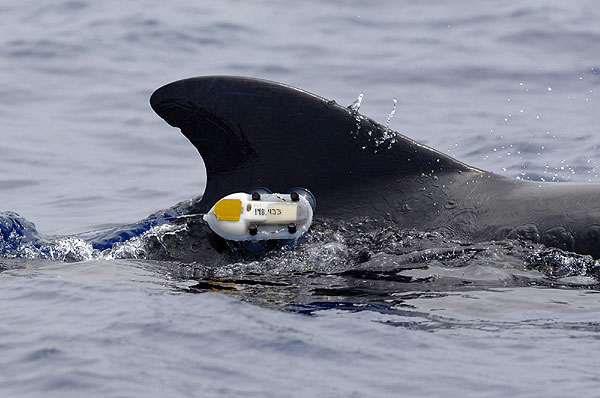


| © AcousticEcology.org, 2001 | Privacy Policy | Site Map |